
7 Best Glass Food Processors
I switched to a glass food processor a few years ago after my third plastic bowl developed hairline cracks and started smelling like garlic no matter how many times I washed it. A glass bowl can be appealing for everyday chopping, but its material does not tell you whether the appliance can process hot food. The lid, seals and motor have their own limits.
The downside, of course, is weight. Glass food processors are heavier and can crack if you drop them, so build quality and bowl thickness matter a lot. I’ve tested several options over the past couple of years and narrowed it down to seven that balance durability, performance, and value. Here’s what to look for, and which models are worth your money.
The Benefits of Glass Food Processors
There is a wide range of food processors on the market, many of which come with plastic bowls. When on the hunt for a good food processor, you may come across some with glass bowls.
These can have a higher price tag when compared to their all-plastic counterparts which will surely make you wonder why you need to invest in a food processor with a glass bowl.
Glass food processors, aside from the benefits that all processors come with, do have other benefits too.
Check the whole food-contact assembly, not just the bowl. A glass bowl may still have a plastic lid, blade hub or other parts. Bowl material alone is not a reason to call an appliance safer or healthier.
Glass makes it easy to see what is happening in the bowl. It still needs careful handling: inspect it for chips or cracks and follow the manufacturer’s replacement advice if it is damaged.
Consider the job as well as the material. If you want to knead, choose a food processor designed for dough. A glass chopping bowl does not establish that a machine can knead.
Thirdly, glass bowls have a non-porous surface. This means that glass bowls don’t absorb and retain odors.
This is important as you will be using your food processors for a range of tasks – from grinding meat and chopping onions to preparing fruit purees.
Do not assume a processor bowl is oven-, microwave- or freezer-safe. Use it that way only when the manufacturer explicitly allows it for that exact bowl. Glass construction is not approval for heating or sudden temperature changes.
Choosing a Glass Food Processor
A high-quality food processor is an investment in making your kitchen a happier place. However, it isn’t the cheapest kitchen appliance.
Because of this, when choosing a glass food processor, you should certainly take your time to make a few considerations.
Bowl Capacity
The capacity of the bowl is the primary feature you should consider when buying a food processor.
When deciding on the bowl capacity, there are two things to keep in mind. First, think about the tasks you will be using the processor for. Second, consider how many portions of food you usually need to cook.
Use the stated capacity to compare bowl sizes, then check the manual’s working-fill limits. Nominal volume is not the amount of every ingredient you can process at once. A practical way to choose is to match the bowl to your usual task:
- Small batches: Check whether the blade can reach and chop a handful of herbs, garlic or nuts. A large bowl is not automatically better for tiny quantities.
- Everyday chopping: Compare the usable fill limit for vegetables or meat with the amount you usually prepare. Work in batches when needed.
- Liquids and purees: Follow the separate liquid-fill and temperature limits. Do not fill to the rim just because a bowl has a large stated volume.
- Heavy or commercial work: Check task approval and duty cycle. Cup capacity alone does not make a household chopper suitable for dough, prolonged running or commercial use.
Processor Size
Once you have chosen the bowl capacity you need for the appliance, consider the overall size of the processor.
Check the measurements provided by the manufacturer and see if the appliance will fit in the space you are planning to store it.
If you won’t be keeping the food processor on the counter at all times, make sure it is not overly bulky for storage in the cupboard.
Blades and Functions
Check whether you are buying a chopper or a full food processor. A top-mounted motor and S-blade are useful for chopping or mincing. Do not assume that setup can produce slices, shred vegetables or knead dough; look for the specific attachments and instructions for those tasks.
Before you make a purchase, think about the tasks you’d want your food processor to perform and buy one that comes with blades and attachments meant for them.
Check the material of the blades to make sure they are durable and rust-resistant. Stainless steel blades are the best for this reason.
Tight-Fitting Lid
Choose an appliance with a properly fitting lid and the required safety interlock, then use it as directed. A tight lid does not make a chopper suitable for hot liquids or turn it into a pressure vessel.
If you want to prep ingredients in separate bowls, check which bowls and blade sets actually come with the selected model. Separate bowls can be convenient, but you still need to clean and handle raw and ready-to-eat foods appropriately.
Use a bowl for food storage only if its instructions allow it and an appropriate storage lid is supplied. A processing lid is not necessarily a storage lid.
Check cleaning instructions for the bowl, lid and blade separately. Dishwasher approval for one part does not cover the rest. Unplug the appliance before disassembly, handle sharp blades carefully and never immerse the motor unit.
Speed Control
If you want to have control over the texture of the food being processed, buy a food processor with multiple speed settings.
Food processors that are on the expensive side tend to have more refined speed control settings. This allows you to achieve the perfect texture for any food.
Stability and Durability
The job of a food processor is not easy. Sometimes it has to deal with tough foods chopping and grinding which can cause vibrations.
It’s important for the body of the food processor to be well-built with high-quality durable materials.
Additionally, pay attention to the base of the food processor. While processors with a wider base take up more space on the kitchen counter, they provide enhanced stability.
Power
Compare the tasks, maximum batch sizes and run/rest times in the manual alongside the wattage. A larger number on the motor label does not establish what the appliance can safely process.
For dough or nut butter, choose a machine whose instructions explicitly support that task. A 600–700W rating alone is not a guarantee, and chopping nuts is different from running a motor long enough to make nut butter.
Quiet Operation
While it is impossible to find a food processor that makes zero noise, you can surely find an option that operates quietly. This is especially important for people who have babies or anyone that finds the noise of a food processor annoying.
You can check the manufacturer’s claims regarding the quiet operation of the appliance. However, we also recommend checking buyers’ reviews for an unbiased opinion.
The 7 Best Glass Food Processors
Quick Picks by Bowl Setup
- Two glass bowl sizes: Bear Dual-Bowl Food Processor (two glass bowls in one box)
- Separate prep bowls: TTFTTF Glass Food Processor (four bowls, four blades)
- One-touch chopping: OROZEE Deluxe Food Processor
Compare the linked configurations by bowl count, material and attachments. Check the selected pack and current price before buying, and use the manual’s fill limit for actual batches. The model names below jump to the details.
| Model | Choose it for | Listed setup |
|---|---|---|
| Bear Dual-Bowl | Two glass bowl sizes | 8-cup + 2.5-cup glass, 400W |
| Ganiza | Glass and stainless options | 8-cup glass + 8-cup steel |
| La Reveuse | Chopping and whisking | 7-cup glass, 300W, whisk disc |
| TTFTTF | Separate prep bowls | 8-cup + three 0.5-cup glass bowls |
| Bear 8-Cup | One large glass bowl | 8-cup glass, 2-speed |
| OROZEE | One-touch chopping | 1.8L listed bowl, 300W |
| Cordless Mini | Small cordless jobs | Compact, rechargeable |
1. Bear Dual-Bowl Food Processor: Two Glass Bowl Sizes
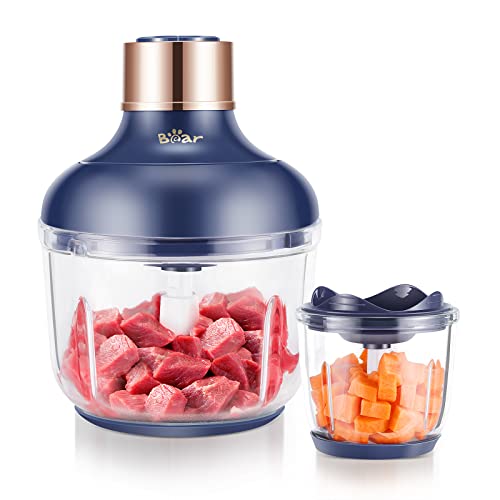
- Two glass bowls: 8-cup and 2.5-cup
- 400W copper motor
- Two sets of stainless steel blades
- Two-speed control
This is the one I reach for most. You get two glass bowls in the box, a big 8-cup for chopping meat and hard vegetables and a small 2.5-cup for herbs, nuts, and baby food, so it really works like two processors in one. The 400-watt motor and two blade sets handle everyday prep without bogging down, and both bowls are glass so they won’t stain or hold onto garlic and onion smells.
2. Ganiza Food Processor: Glass and Stainless Bowls

- 8-cup glass bowl plus an 8-cup stainless bowl
- Two-speed control
- Overheat protection indicator
- Ergonomic press-to-run buttons
The Ganiza is a smart pick if you want options. It ships with both a glass bowl and a stainless bowl in the same capacity, so you can use glass for acidic or smell-prone foods and stainless when you want something lighter and shatter-proof. An overheat indicator and an easy press-button design make it forgiving for daily use.
3. La Reveuse 7-Cup Food Processor: Chopping and Whisking

- 7-cup (1.7L) glass bowl
- 300W motor
- Four bi-level stainless blades
- Whisking disc included
- Quiet operation
La Reveuse lists a 7-cup (1.7L) glass bowl, a 300W motor, a chopping blade and a whisking disc for eggs. These are chopping and whisking features, not confirmation that it can knead dough. Its own product instructions limit continuous operation to 30 seconds, require two-minute rests between uses and a 15–20 minute rest after three cycles. They also prohibit hot liquids and ingredients above 122°F (about 50°C). Follow the instructions supplied with your model if they are more restrictive.
4. TTFTTF Glass Food Processor: Separate Prep Bowls
- 8-cup main glass bowl plus three 0.5-cup mini bowls
- Four blades supplied with the set
- Designed for batch prep and portioning
For anyone who preps in batches, the four-bowl TTFTTF set is built for it. The large 8-cup glass bowl handles the heavy chopping while the three small glass bowls let you portion sauces, dressings, and spice blends in one session instead of washing the same bowl over and over. The four blades cover chopping, mincing, and pureeing.
5. Bear 8-Cup Food Processor: One Large Glass Bowl

- 8-cup (2L) handheld glass bowl
- Two-speed control (soft and hard foods)
- No-hole bi-level stainless blades
If you’d rather keep it simple than juggle multiple bowls, this single 8-cup Bear is a clean choice. Speed I handles soft foods like onions and baby food, Speed II powers through meat and carrots, and the no-hole blade design means less food gets stuck under the blade base when you pour out a batch.
6. OROZEE Deluxe Food Processor: One-Touch Chopping

- 1.8L (8-cup) glass bowl
- 300W motor
- Simple one-touch operation
The OROZEE listing describes a 1.8L glass bowl and a 300W motor. Compare the current price and included parts rather than assuming it is always the cheapest option. A nominal 1.8L volume is about 7.6 US cups; the safe working fill may be lower and depends on the instructions and ingredient.
7. Cordless Mini Food Processor: Small Cordless Jobs

- Compact, rechargeable cordless design
- Lightweight and portable
- Best for small jobs and travel
When you only need to chop half an onion or a handful of garlic, hauling out a full-size processor feels like overkill. This rechargeable mini is the grab-and-go option, light enough to take to a cabin or RV and small enough to wash in seconds. It’s the pick for quick jobs rather than big-batch prep.
Choose around the task you actually do most often: small quantities, separate prep bowls or a larger chopping batch. Before ordering, confirm the exact model, bowl material, included parts and care instructions on the selected listing. None of those checks can be replaced by the word ‘glass’ in the title.
Related Food Processor Guides
- 9 Best Food Processors for Nut Butter
- 9 Quietest Food Processors
- 9 Cheapest Food Processors (That Still Get the Job Done)
Frequently Asked Questions
Are glass food processors better than plastic ones?
It depends on what you need. Glass lets you see the contents and may suit your preference for a glass food-contact bowl, but it is heavier and can chip or crack. A glass bowl does not make the entire appliance plastic-free or establish that it is safer than another model.
Is the glass bowl dishwasher safe?
Check the exact model’s care instructions for each part. Do not assume the lid or blade is dishwasher-safe because the glass bowl is. Unplug before disassembly and never immerse the motor unit.
Can a glass food processor bowl handle hot ingredients?
Do not assume it can. Follow the exact appliance’s temperature and hot-liquid restrictions, including those for its lid and seals. For example, La Reveuse’s LARB4016 instructions prohibit hot liquids and ingredients above 122°F (about 50°C). A few minutes of cooling is not a reliable temperature check, and a heat-resistant glass bowl does not override the appliance instructions.
What size glass food processor do I need?
Choose by batch size and the manual’s maximum fill for the ingredient. A small bowl can suit herbs and dips; a larger bowl can reduce the number of chopping batches. Nominal cup capacity does not establish a serving count, commercial suitability or permission to knead dough.
Do glass food processors break easily?
Glass can chip or crack after impacts or temperature changes. Inspect the bowl before use, handle it carefully when full and stop using a damaged bowl. Follow the manufacturer’s guidance for replacement parts and temperature limits.

Hi Jaron!
Thank you for this listing. Have you seen any food processors with glass bowls, that do NOT contain metal as part of the bowl? It would be great to be able to microwave something in the bowl before processing it. But I sense most all bowls are going to use a metal peg for the blade insert to align onto.
Figured it couldn’t hurt to ask you though!
Thanks
M
None of these are available on Amazon!